The Electron: The Tiny Particle That Runs the Modern World
Every phone, laptop and power grid comes down to one particle with a negative charge. Here is how we found the electron, how it behaves, and how we learned to steer it.
Pick up your phone. Inside it, billions of electrons are being pushed, blocked, stored and released billions of times every second. Every photo you take, every message you send, every song you stream is, in the end, a pattern of electrons moving through metal and silicon.
The electron is the smallest thing most of us depend on every day. This notebook is named after it, so it seems like the right place to start.
Meet the electron
An electron is a subatomic particle with a negative electric charge. It weighs about 9.11 × 10⁻³¹ kg, roughly 1/1836 the mass of a proton. As far as anyone can measure, it has no internal parts. Unlike protons and neutrons, it isn't made of anything smaller.
A few numbers to hold in your head:
- Charge: −1.602 × 10⁻¹⁹ coulombs, the smallest free unit of charge in nature
- Mass: 9.109 × 10⁻³¹ kg, so you'd need about 10³⁰ of them to make a kilogram
- Size: as far as we can tell, effectively a point
- Count: one amp of current means about 6 quintillion electrons passing every second
Not a tiny planet
The classic picture (including the logo at the top of this site) shows electrons circling the nucleus like planets. It's a lovely symbol, but it's wrong.
Quantum mechanics says an electron is better described as a cloud of probability, called an orbital, showing where it is likely to be found. And electrons can only sit at specific energy levels. That one fact explains chemistry, the colours of light, and why some materials conduct electricity while others don't.
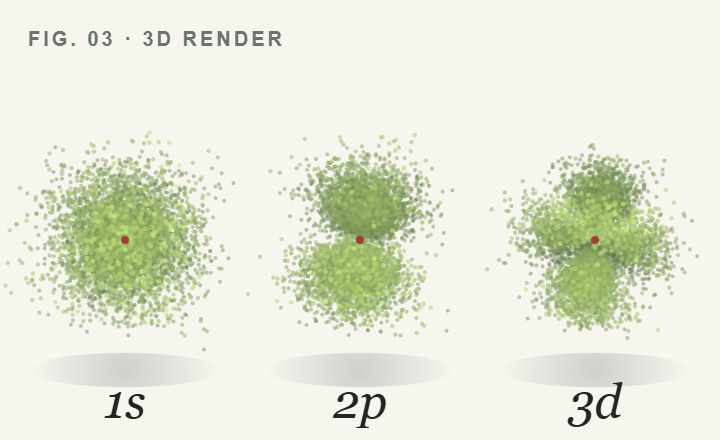
Fig. 3: Each dot is a place you might find the electron if you looked. Dense regions are likely, empty regions are not.
Fifty years from discovery to the transistor
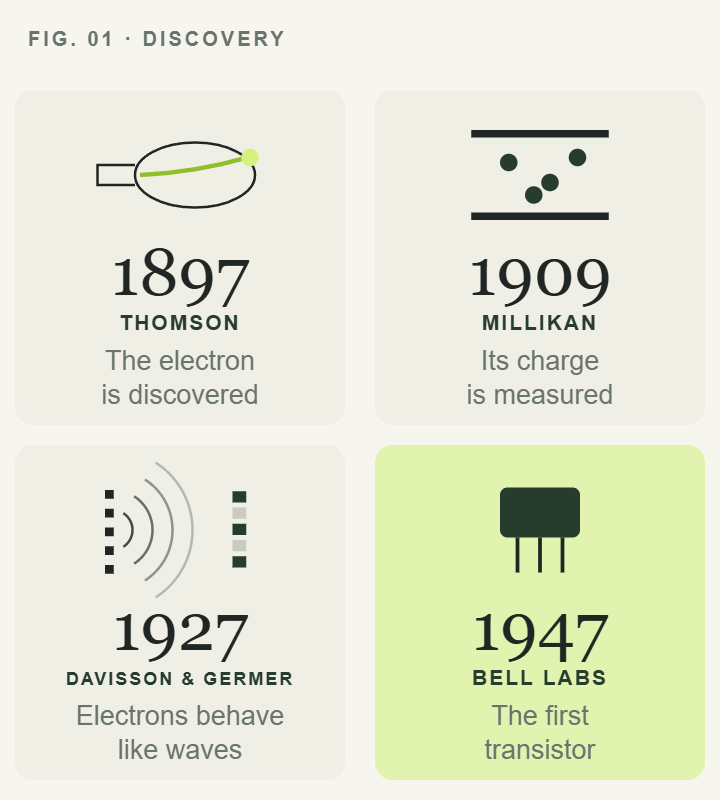
Fig. 1: From a glowing glass tube to the first transistor in fifty years.
- 1897: J.J. Thomson, working with cathode-ray tubes, showed that these glowing "rays" were streams of tiny charged particles far lighter than any atom. The electron was the first subatomic particle ever discovered.
- 1909: Robert Millikan's oil-drop experiment measured the electron's charge, the basic unit of electric charge.
- 1924 to 1927: Louis de Broglie proposed that electrons also behave like waves, and Davisson and Germer confirmed it by watching electrons diffract off a crystal. The electron turned out to be both particle and wave.
- 1947: At Bell Labs, Bardeen, Brattain and Shockley built the first transistor, and modern electronics began.
Conductors, insulators, and the in-between
Whether a material carries electricity depends on how freely its electrons can move. Physicists picture this as energy bands: a lower valence band where electrons are bound, and a higher conduction band where they can roam.
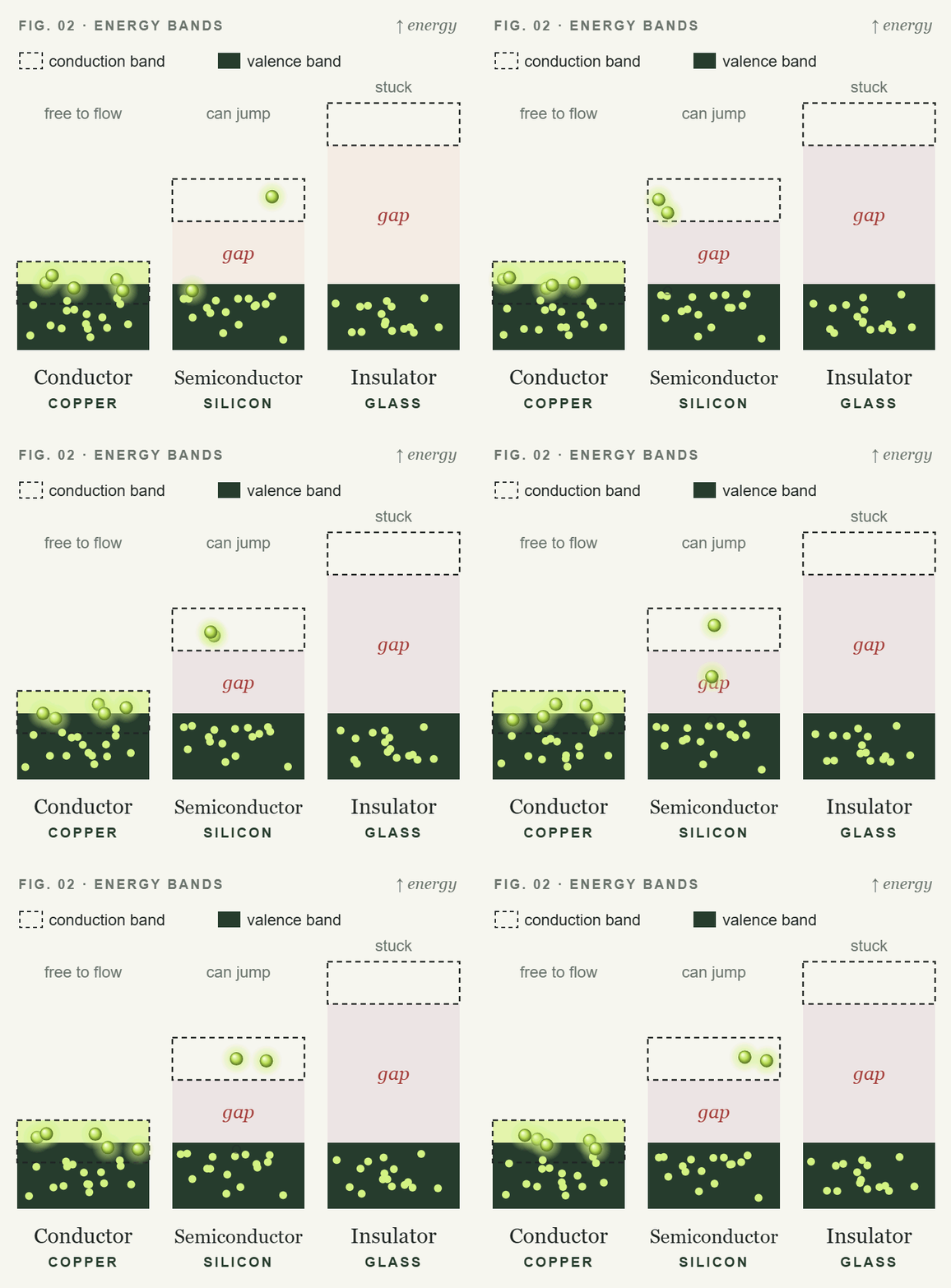
Fig. 2: Copper’s bands overlap, so electrons flow freely. Silicon has a small gap that electrons can jump. Glass has a gap too wide to cross.
- Conductors like copper have bands that overlap. Their outer electrons drift through the metal as a shared "sea", so a small voltage gets them moving.
- Insulators like glass hold their electrons tightly. A large energy gap, the band gap, separates them from any state where they could move.
- Semiconductors like silicon sit in between. Their gap is small, and that is exactly what makes them useful.
Doping: a pinch of impurity
Pure silicon isn't very interesting. The magic happens when engineers add tiny, carefully measured amounts of other elements. This is called doping.
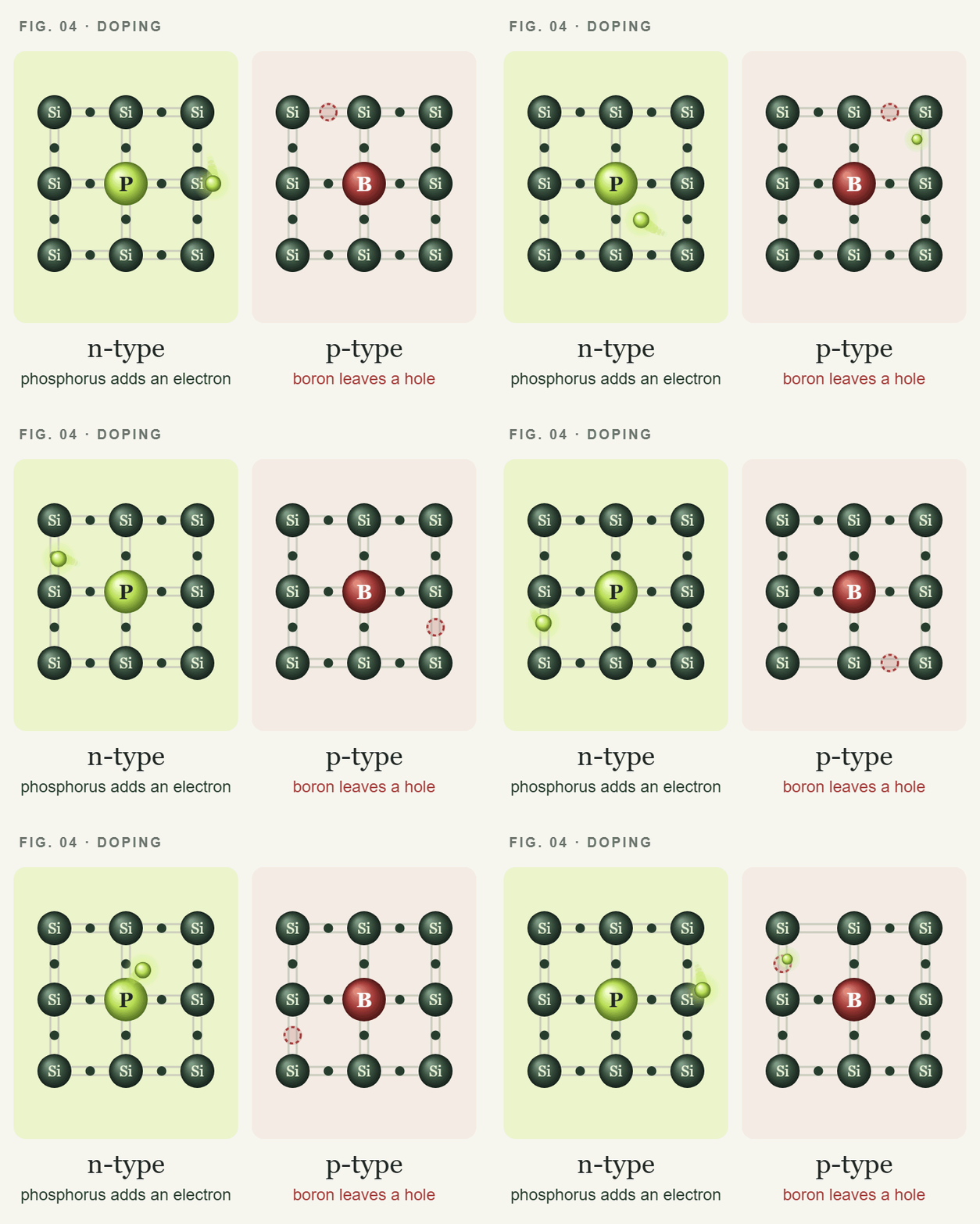
Fig. 4: Phosphorus brings a spare electron that roams free. Boron leaves a hole; neighbouring electrons keep filling it, so the hole seems to wander.
- Add phosphorus, which has one more outer electron than silicon, and that spare electron wanders free. This is n-type silicon.
- Add boron, which has one fewer, and you leave a gap called a hole. Neighbouring electrons hop into it, so the hole itself seems to move, acting like a positive charge. This is p-type silicon.
Put n-type and p-type side by side and you get a p-n junction: the heart of diodes, LEDs, solar cells and transistors.
The transistor: a switch made of electrons
A transistor is a switch with no moving parts. In the most common kind, the MOSFET, a small voltage on the gate creates an electric field through a thin insulating layer. That field pulls electrons into a narrow channel between the source and the drain.
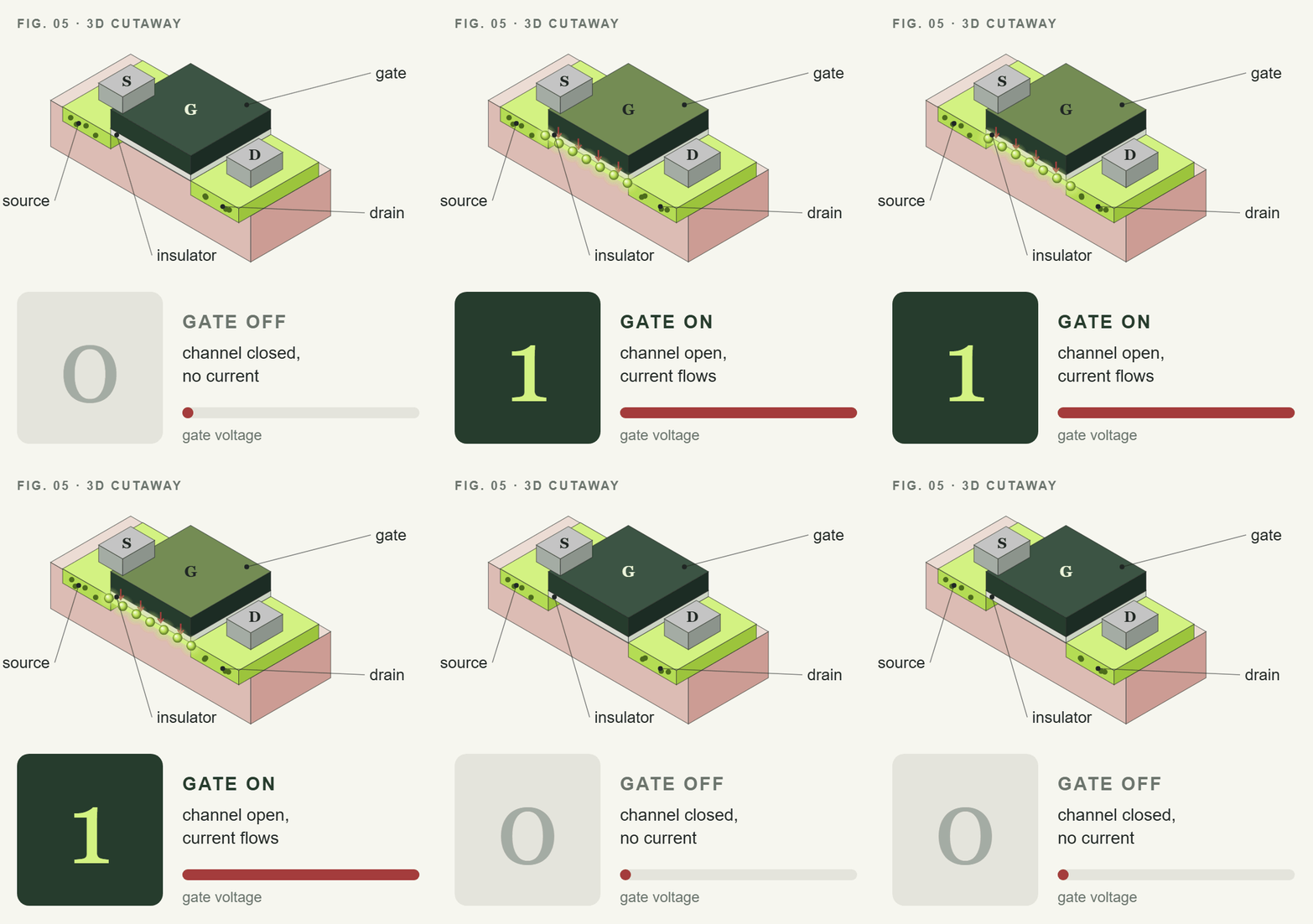
Fig. 5: Raise the gate voltage and a channel opens under the insulator. Electrons flow from source to drain, and the switch reads 1.
Channel open: current flows, and that's a 1. Channel closed: no current, and that's a 0.
That's the whole trick. Connect enough of these switches and you can build logic gates, then adders, then memory, then entire processors.
Billions of switches, and counting
In 1971 the Intel 4004 held about 2,300 transistors. Today's largest chips hold more than 200 billion. For decades the count doubled roughly every two years, a trend known as Moore's law.
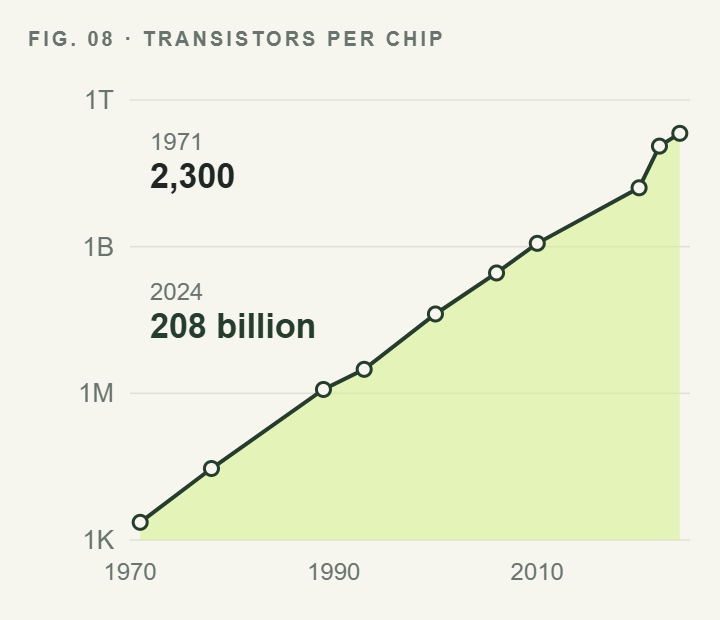
Fig. 8: Doubling every two years means roughly a thousandfold increase every twenty. Note the log scale.
The smallest features on modern chips are only a few nanometres across, which is small enough that engineers have to design around the quantum behaviour of the electrons themselves.
Where electrons work in your devices
- Processors: billions of transistors switching electrons on and off to do arithmetic and logic.
- Memory: flash storage traps electrons in an isolated charge layer, where they can stay for years without power. That's how your photos survive switching your phone off.
- Screens: in an LED, an electron falls into a hole and gives up its energy as a particle of light. The colour depends on the material's band gap.
- Solar panels: the reverse of an LED. Light knocks electrons loose at a p-n junction, and the junction pushes them out as current.
- Cameras: your camera sensor counts electrons freed by incoming light, pixel by pixel.
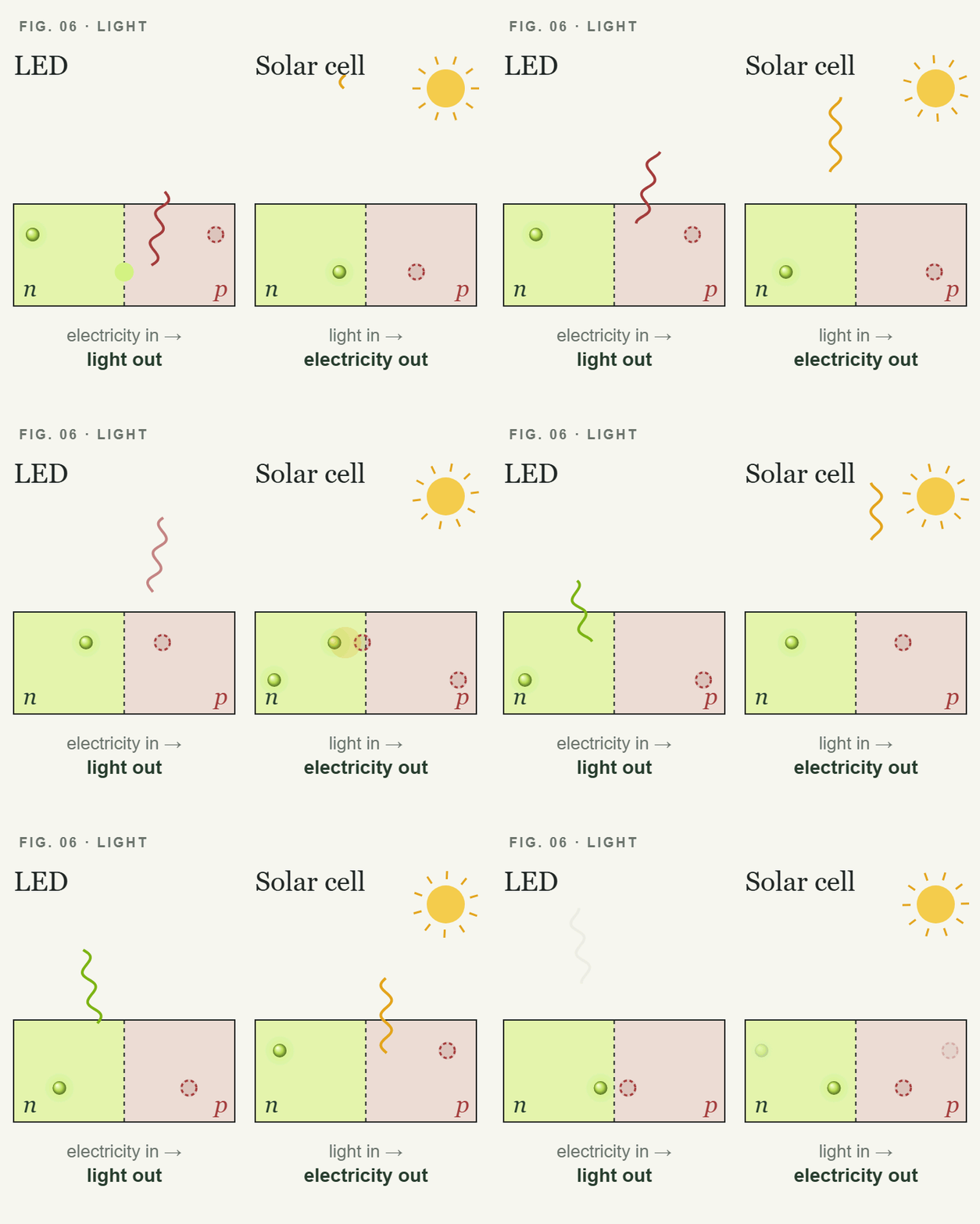
Fig. 6: In an LED, electrons and holes meet at the junction and release light. A solar cell runs the same process in reverse.
The surprising speed of electricity
When you flip a switch, the light comes on almost instantly. But the electrons in the wire barely move. Their average drift velocity in a typical household copper wire is often well under a millimetre per second: slower than a snail.
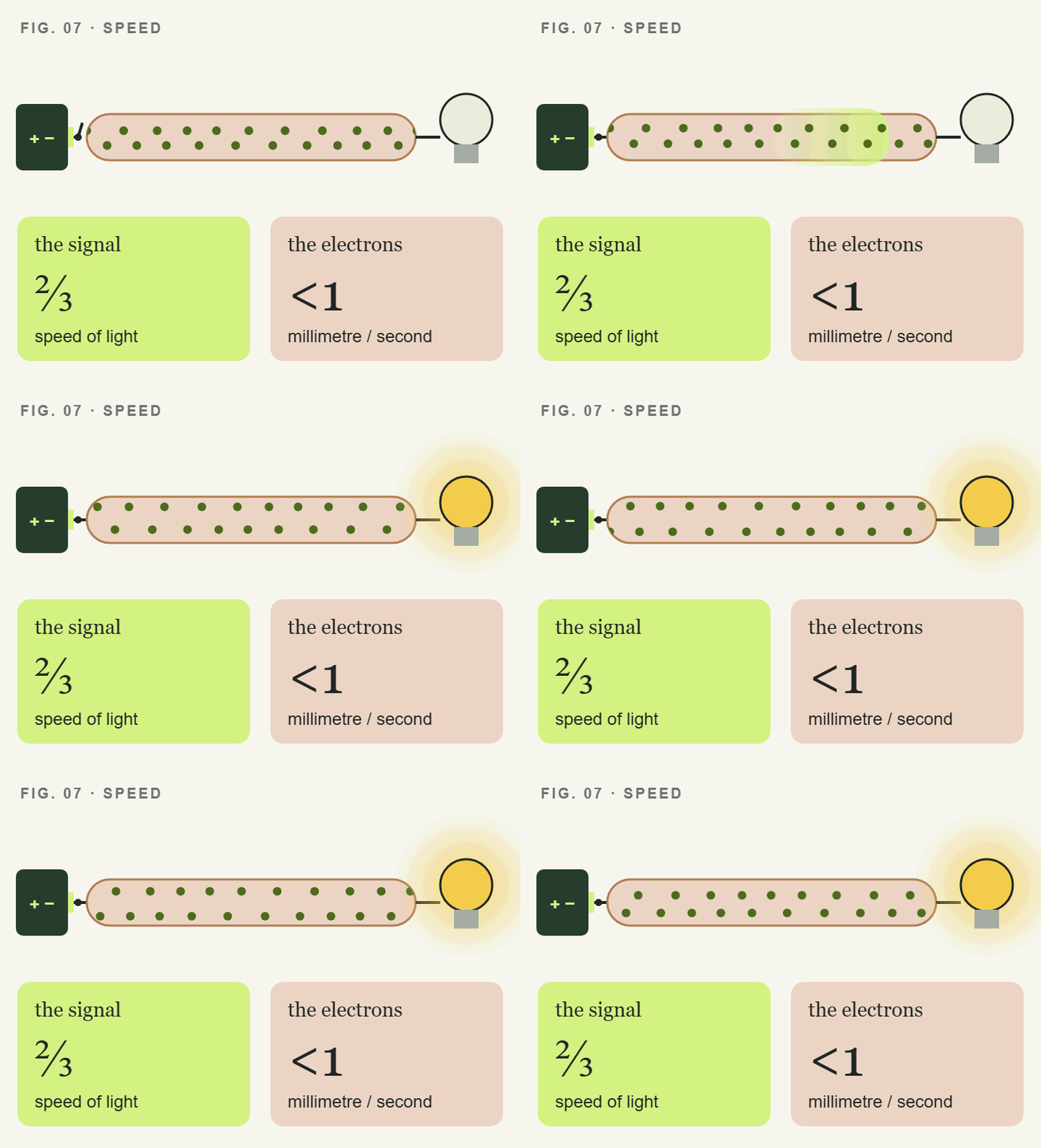
Fig. 7: The electrons’ drift is exaggerated here so you can see it.
What travels fast is the electromagnetic field along the wire, which sets all the electrons moving at nearly the same moment. Think of a pipe already full of water: push at one end and water comes out the other end immediately, even though no single drop crossed the whole pipe.
Where the electron takes us next
As transistors approach the size of a few atoms, electrons start doing strange things, like tunnelling through barriers they shouldn't be able to cross. That's a headache for classical chips, and also an opportunity:
- Spintronics uses the electron's spin, not just its charge, to store and process information.
- Quantum computing uses particles, electrons among them, in superposition to compute in ways ordinary bits can't.
- New materials like graphene and gallium nitride let electrons move faster and handle more power than silicon.
More than a century after Thomson found it, the electron is still the main character of electronics, and we're still learning new ways to use it.
This is the first entry in the Crazy Electron notebook. More experiments and ideas are on the way. Stay curious.